
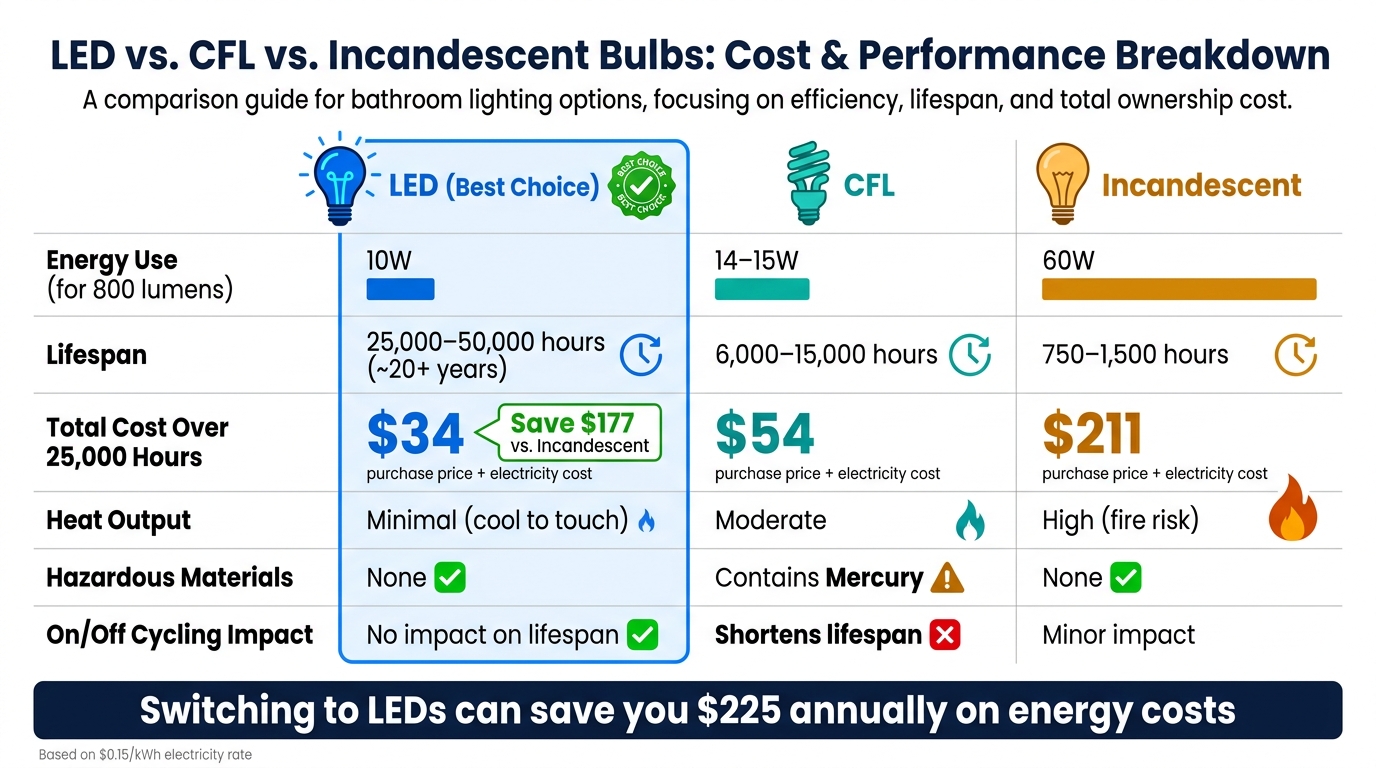
LED lighting is a game-changer for bathrooms. It uses up to 90% less energy than incandescent bulbs, lasts 25 times longer, and performs better in humid, high-use spaces. Switching to LEDs can save you $225 annually on energy costs while reducing the hassle of frequent bulb replacements. Plus, LEDs stay cool, handle frequent on/off cycles, and are safer for moisture-prone areas. For specialized installations, consult our guide to shower niche lighting kits.
Key Takeaways:
- Energy Efficiency: LEDs consume just 10 watts for the same brightness as a 60W incandescent bulb.
- Cost Savings: Over 25,000 hours, LEDs cost $34 compared to $211 for incandescent bulbs.
- Durability: LEDs withstand humidity and frequent switching, lasting 25,000–50,000 hours.
- Safety: No heat buildup or hazardous materials like mercury.
Quick Comparison:
| Feature | LED | CFL | Incandescent |
|---|---|---|---|
| Watts (800 lumens) | 10W | 14W–15W | 60W |
| Lifespan (hours) | 25,000–50,000 | 6,000–15,000 | 750–1,500 |
| Total Cost | $34 | $54 | $211 |
| Heat Output | Minimal | Moderate | High |
| Hazardous Materials | None | Contains mercury | None |
LEDs are the clear choice for efficient, durable, and safe bathroom lighting. Whether you’re upgrading vanity lights or adding bathroom niche lighting, LEDs offer long-term savings and improved performance in demanding conditions.
LED vs. CFL vs. Incandescent: Full Cost & Performance Breakdown
Energy Efficiency: LED vs. Traditional Bulbs
When you’re choosing lighting for your bathroom, the efficiency of the bulb can make a big difference. Bathrooms are high-use areas, so even small energy savings can add up quickly.
Lumens and Watts Explained
Let’s break down two common lighting terms: lumens and watts. Lumens measure the amount of light a bulb produces, while watts tell you how much energy it consumes. A higher wattage doesn’t mean brighter light – it just means more energy use. LEDs are particularly efficient because they use semiconductor technology to convert electricity directly into light. On the other hand, traditional incandescent bulbs waste about 90% of their energy as heat rather than light. This fundamental difference is key to understanding the energy savings LEDs can offer.
Energy Consumption by Bulb Type
Here’s a quick comparison of the energy consumption and lifespan of different bulb types when producing similar brightness:
| Bulb Type | Watts for ~800 Lumens | Lifespan (Hours) |
|---|---|---|
| LED | 10W | 25,000 – 50,000 |
| CFL | 14W – 15W | 6,000 – 15,000 |
| Halogen | 55W | 2,000 – 4,000 |
| Incandescent | 60W | 750 – 1,500 |
Take a standard vanity fixture with six 60W incandescent bulbs. That setup uses 360 watts every time you flip the switch. Replace those with 10W LEDs, and you’ll only use 60 watts for the same brightness. That’s a huge reduction in energy use, which translates to noticeable savings on your electricity bill.
But energy savings aren’t the only reason LEDs are a smart choice for bathrooms.
How LEDs Handle Frequent On/Off Switching
Bathroom lights often get turned on and off multiple times a day. This constant cycling can shorten the lifespan of traditional bulbs, especially CFLs. LEDs, on the other hand, are built to withstand frequent switching without losing performance, thanks to their solid-state design.
Naomi Miller, Senior Lighting Engineer at Pacific Northwest National Laboratory, sheds light on CFL efficiency:
"CFLs are about four times more efficient than the equivalent wattage of incandescent bulbs. So if you take the wattage of the CFL and multiply it by four, that equals the incandescent bulb you would replace."
While CFLs are a step up from incandescent bulbs in terms of efficiency, LEDs still outshine them – particularly in bathrooms where lights are switched on and off so often. For tasks like grooming or applying makeup, where consistent, high-quality light is essential, LEDs are the better option. They not only save energy but also offer durability and reliability, making them a practical and cost-effective choice for demanding bathroom environments.
sbb-itb-6294289
Cost Savings Over Time
Upfront Costs vs. Long-Term Savings
When it comes to lighting, the upfront price tag doesn’t tell the whole story. While incandescent bulbs are the cheapest to buy – usually between $1.00 and $2.70 per bulb – they’re the most expensive to operate. CFLs fall in the middle, costing anywhere from $2.00 to $15.00, while LEDs range from $2.00 to $20.00, depending on features like dimming or smart controls.
However, LEDs quickly make up for their higher upfront cost. They use 90% less energy than incandescent bulbs and have a much longer lifespan. This means fewer replacements, lower electricity bills, and reduced hassle over time.
Cost Comparison Example
Let’s break it down with an example. Imagine a bathroom vanity using a single 60W-equivalent bulb for about 1,000 hours annually. Over a 10-year period, an incandescent bulb would cost $93.00 – about $56.00 in electricity and the rest in annual replacements. In contrast, an LED bulb would cost just $18.00 over the same time frame, thanks to its lower wattage and lifespan of 25,000–50,000 hours. That’s a savings of $75 per bulb over a decade. Multiply that by several fixtures, and the savings add up quickly.
As science journalist Tyler Santora explains:
"In the time you use one LED, you can spare 30 incandescent bulbs from being produced, shipped, and trashed."
The financial and environmental benefits become even clearer when you look at the numbers over a longer period.
Total Cost of Ownership: Comparison Table
The table below shows the full cost breakdown for 25,000 hours of use – roughly the lifespan of a single LED bulb.
| Feature | Incandescent | CFL | LED |
|---|---|---|---|
| Watts used (60W equivalent) | 60W | 14W | 7W |
| Average lifespan | 1,200 hours | 8,000 hours | 25,000 hours |
| Bulbs needed for 25,000 hours | 21 | 3 | 1 |
| Total purchase price | $21.00 | $6.00 | $4.00 |
| Cost of electricity | $169.00 | $52.00 | $30.00 |
| Total estimated cost | $211.00 | $54.00 | $34.00 |
Based on $0.15 per kWh.
Over the long haul, LEDs cost six times less than incandescent bulbs and 37% less than CFLs. And in places like bathrooms, where lights are frequently switched on and off, the savings grow even more. Unlike CFLs, which degrade with frequent use, LEDs remain unaffected.
Durability and Safety in Bathrooms
Lifespan and Reliability by Bulb Type
Bathrooms can be a harsh environment for light bulbs. High humidity, temperature fluctuations, and frequent on/off cycles can quickly shorten the life of incandescent bulbs. For instance, an incandescent bulb used for just four hours daily might only last 3 to 6 months before needing replacement. While compact fluorescent lamps (CFLs) are designed to last longer, their performance in bathrooms often falls short. As one user on BudgetLightForum noted:
"In a bathroom it [CFL] might last a few months to a year or two… CFL is dead." – Bort, BudgetLightForum
LEDs, however, are built to handle these challenges. Unlike other bulbs, their lifespan isn’t affected by frequent switching. With a rated lifespan of 25,000 to 50,000 hours, a single LED bulb can last over 20 years in a typical bathroom setting.
This longevity also contributes to safer and more reliable lighting in moisture-prone spaces.
Safety Differences Between Bulb Types
Safety is a key consideration in bathrooms, where moisture and confined spaces amplify risks. Incandescent bulbs generate a lot of heat, which can cause burns, discolor fixtures, or even pose a fire hazard. As Leo Lam, CEO of Lawrence & Scott, points out:
"Incandescent bulbs generate significant heat, while LEDs remain relatively cool. Excessive heat can pose safety risks, cause discoloration of lamp shades, and create discomfort, especially in confined spaces… LED bulbs mitigate these concerns, making them a much safer choice."
CFLs present a different type of hazard – mercury exposure. If a CFL breaks, it releases toxic vapors and requires careful cleanup. LEDs, on the other hand, contain no hazardous materials and are encased in shatter-resistant plastic, making them a safer and more durable option for bathroom use.
| Feature | LED | CFL | Incandescent |
|---|---|---|---|
| Lifespan | 25,000–50,000 hrs | 6,000–15,000 hrs | 750–2,000 hrs |
| Heat Output | Minimal; cool to touch | Moderate | High; fire risk |
| Hazardous Materials | None | Contains mercury | None |
| Durability | Shatter-resistant plastic | Fragile glass tubes | Fragile glass/filament |
| On/Off Cycling | No impact on lifespan | Shortens lifespan | Minor impact |
With their durability, cooler operation, and absence of hazardous materials, LEDs are well-suited for the demanding conditions of a bathroom.
Waterproof LED Kits for Bathrooms
For spaces directly exposed to water, such as shower niches and floating vanities, waterproof lighting is essential. IP-rated waterproof LED strips are a smart solution for these wet zones.
Thunder Bunny offers LED lighting kits specifically designed for bathrooms. Their 24V COB LED strips are waterproof and safe to use in areas exposed to steam or splashing water. Floating vanity kits are priced between $39.00 and $150.00, while shower niche kits range from $249.00 to $350.00. Both options include installation videos to simplify the setup process. These kits combine safety, durability, and style, making them a practical choice for bathroom lighting.
Functional Bathroom Design with LED Lighting
Task Lighting and Color Accuracy
Bathroom lighting isn’t just about how bright it is – it’s also about how true-to-life it makes colors appear. Whether you’re shaving, applying makeup, or getting ready for the day, the quality of the light can make a big difference.
LEDs with a CRI (Color Rendering Index) of 90+ and color temperatures between 3,400K and 4,000K are ideal for these tasks. This range closely mimics natural daylight but without generating excessive heat. By using these high-quality LEDs, you can create precise task lighting that not only enhances functionality but also lays the foundation for a beautifully layered lighting design.
Ambient and Accent Lighting with LEDs
LED lighting isn’t just practical – it’s also a fantastic tool for adding personality and style to your bathroom. Ambient lighting, often achieved with recessed ceiling fixtures, provides general illumination. For a softer, more inviting feel, aim for a color temperature between 2,700K and 3,000K. This avoids the harsh, clinical brightness often associated with fluorescent lights.
Accent lighting takes things a step further. LEDs excel at creating targeted effects, making them perfect for adding a touch of luxury. For example, LED strips can be installed in shower niches or under floating vanities to give your bathroom a sleek, spa-like vibe. Thunder Bunny offers specialized solutions like the Shower Niche LED Lighting Kits ($249.00–$350.00) and Floating Vanity LED Light Kits ($39.00–$150.00). These waterproof, dimmable kits are designed specifically for wet areas, allowing you to create a relaxing ambiance without sacrificing safety.
Layered Lighting Without High Energy Costs
One of the best things about LEDs is their energy efficiency, which makes it easier to layer multiple types of lighting without worrying about high utility bills. This means you can combine recessed ambient lights, vanity sconces, and accent strips to enhance your bathroom’s design while keeping energy use in check.
Adding dimmer switches to each lighting layer gives you even more control, letting you adjust the brightness to suit your needs – bright and clear for morning routines or warm and cozy for evening relaxation. This kind of flexibility simply wasn’t feasible with older lighting technologies.
| Light Layer | Fixture Type | Recommended CCT | Primary Purpose |
|---|---|---|---|
| Ambient | Recessed ceiling lights | 2,700K–3,000K | General illumination |
| Task | Vanity bar, wall sconces | 3,400K–4,000K | Grooming and makeup |
| Accent | LED strips (niches, vanities) | 2,700K–4,000K | Highlighting features |
Conclusion: Making the Switch to LED
LED lighting offers a smart solution for bathrooms, combining energy efficiency, durability, and safety. These lights use up to 90% less energy than traditional incandescent bulbs and can last up to 25 times longer – making them a cost-effective and eco-friendly option.
In bathroom environments, where humidity and frequent use are common, LEDs truly shine. They stay cool to the touch, resist moisture, and are designed to withstand wear and tear. Plus, they’re mercury-free, which makes disposal straightforward and safer compared to fluorescent options. Whether you need bright, focused lighting for your vanity or softer, ambient lighting for relaxation, LEDs give you the flexibility to design the perfect setup, including chic shower lighting for smaller spaces.
To enhance savings and performance, consider ENERGY STAR-certified bulbs and take advantage of rebates offered by local utility providers. Pairing LEDs with dimmer switches can also help you customize lighting while keeping energy consumption low.
For bathroom-specific needs, Thunder Bunny provides contractor-approved LED kits designed for wet areas. Options like their Shower Niche LED Lighting Kits (priced between $249.00–$350.00) and Floating Vanity LED Light Kits ($39.00–$150.00) are dimmable, waterproof, and come with detailed guides to make installation simple and stress-free.
Switching to LEDs is an easy way to improve your bathroom’s efficiency, safety, and overall aesthetic. Why wait? Start upgrading today!
FAQs
How many LED bulbs do I need to match my current bathroom brightness?
To achieve the right brightness in your bathroom using LED bulbs, focus on lumen output rather than wattage. Bathrooms generally require between 4,000 and 8,000 lumens for proper lighting.
For example, if you’re replacing four 60-watt incandescent bulbs (which collectively provide about 3,200 lumens), opt for four LED bulbs that deliver 800 lumens each. Always double-check the lumen rating on your LED bulbs to ensure they provide the brightness you need.
Will LED bulbs work with my existing bathroom dimmer switch?
Yes, LED bulbs can work with a bathroom dimmer switch, but only if the dimmer is designed to handle LED lighting. Some LED bulbs might require a specific type of dimmer to avoid flickering or uneven dimming. Be sure to verify the compatibility of your dimmer with LED bulbs to ensure they function properly.
What IP rating should LED strips have for showers and other wet zones?
LED strips installed in showers or other wet areas need to have an IP67 rating at a minimum. This rating guarantees they are water-resistant and suitable for use in environments exposed to moisture.
Related Blog Posts