
LED lighting can completely transform your bathroom into a functional and stylish space. Here’s a quick breakdown of five key configurations:
- Vanity Task Lighting with Side Sconces: Offers balanced, shadow-free lighting for grooming. Costs range from $249 to $350.
- Backlit Mirrors: Provides soft, even illumination for grooming and ambiance. Prices vary widely, from $200 to $2,300.
- Under-Vanity and Toe-Kick Lighting: Adds a soft glow for accent and nighttime navigation. Costs range from $50 to $600.
- Shower Niche Recessed Lighting: Highlights tiles and creates a spa-like atmosphere. Costs typically range from $249 to $350.
- Programmable Layered Lighting Systems: Combines task, ambient, and accent lighting with smart controls. Starting costs are around $315.
Each option balances energy efficiency, practicality, and cost, making it easier to find the right fit for your bathroom needs.
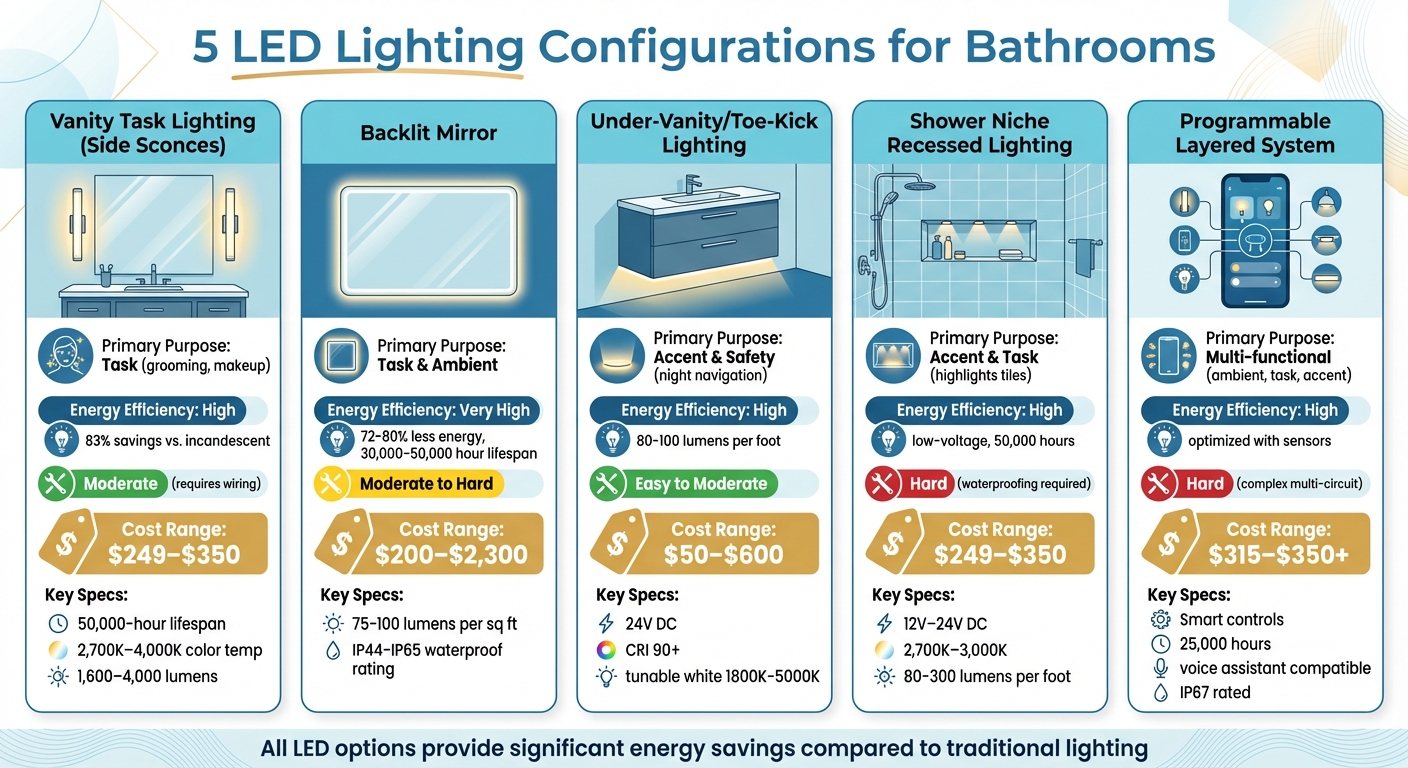
LED Bathroom Lighting Configurations Comparison: Cost, Efficiency & Installation
1. Vanity Task Lighting with Side Sconces
Lighting Purpose (Task, Ambient, Accent)
Side sconces are a game-changer for grooming tasks, as they ensure even lighting on both sides of your face, eliminating those pesky shadows. To get the best results, mount the fixtures 60–66 inches from the floor and just a few inches away from the edge of the mirror. Unlike overhead lights, which tend to cast unflattering shadows under your eyes, nose, and chin, side-mounted sconces provide a balanced, shadow-free glow. This setup not only improves visibility but also enhances energy efficiency and overall performance.
Energy Efficiency and Compatibility
On top of their sleek design, LED sconces are highly energy-efficient. These fixtures boast a 50,000-hour lifespan, running on a 110–120V AC input that’s converted to 24V DC. Many LED kits receive glowing 5.0/5 ratings and are compatible with both standard and dimmable switches from trusted brands like Lutron and Leviton.
Ease of Installation and Maintenance
The use of standard sockets makes swapping bulbs a breeze, whether you’re adjusting brightness or color temperature. For hassle-free maintenance, install power converters in dry, easily accessible spots, such as under the vanity. To meet building codes, hire a licensed electrician to connect the converter to your home’s light switch system [13,5]. Fixtures with frosted glass or diffusers are a smart choice, as they help reduce glare from exposed bulbs positioned at eye level.
Cost Range and Customization Options
Expect to pay between $249 and $350 for LED bathroom kits, with dimmer switches costing around $22 [4,14]. When selecting bulbs, aim for a color temperature between 2,700K and 4,000K – opt for 2,700K–3,000K for a soothing spa-like vibe or 3,500K–4,000K for more precise lighting. Look for bulbs with a CRI of 90 or higher and a brightness range of 1,600–4,000 lumens, depending on the size of your vanity.
sbb-itb-6294289
2. Backlit Mirror with Ambient Surround
Lighting Purpose (Task, Ambient, Accent)
Backlit mirrors provide a soft, even glow around their edges, eliminating harsh shadows and making grooming tasks more comfortable. Unlike traditional overhead lighting, which can cast unflattering shadows, this type of illumination offers uniform brightness that works well for both task-oriented and ambient lighting needs. As Thunder Bunny Co explains:
Lighting has the power to influence mood and ambiance. Soft, warm lighting can create a relaxing spa-like atmosphere, while bright, cool lighting can energize and invigorate.
With an output of at least 75 to 100 lumens per square foot, these mirrors ensure sufficient brightness for detailed grooming tasks while adding a touch of sophistication to your space. Plus, they deliver energy efficiency alongside an enhanced grooming experience.
Energy Efficiency and Compatibility
Backlit mirrors combine style with energy-saving technology. Their LED components consume 72%–80% less energy than traditional bulbs and have a lifespan of 30,000 to 50,000 hours – translating to about six years of continuous use [13,18]. They are designed to work with standard 110V/120V circuits, using a driver to convert power to low voltage [4,14]. Many high-quality mirrors are compatible with dimmable switches from trusted brands like Lutron and Leviton, giving you control over brightness throughout the day with smart lighting tips to maximize your space. When selecting a mirror, look for waterproof ratings between IP44 and IP65 to ensure durability in a moisture-prone bathroom environment. This thoughtful design balances efficiency with aesthetics.
Ease of Installation and Maintenance
For installation, place the LED driver in a ventilated, easy-to-access spot behind the mirror. Aluminum channels paired with plastic diffusers ensure the light is evenly distributed [4,14]. Choosing the right color temperature is key: 3,000K to 3,500K offers a warm, inviting glow, while 4,000K provides a more modern, neutral brightness [17,18]. This setup not only guarantees reliable performance but also simplifies maintenance down the line.
Cost Range and Customization Options
Pre-made backlit mirrors are available in a wide price range, from $200 to $2,300, depending on size and features. For those who prefer a custom touch, DIY LED trim kits cost between $249 and $350 [4,14,19]. Beyond affordability and ease of installation, these mirrors offer plenty of ways to personalize your setup. Customers often mention the "luxury upgrade" feel and the detailed installation support provided. You can choose from various color temperatures – like 3,000K (warm yellow), 4,000K (warm white), or 6,000K (bright white) – and even incorporate RGB strips for dynamic, color-changing effects [6,13,14]. High-end features like anti-fog technology are also available for added convenience. These options make it easy to adapt the lighting to your bathroom’s design and your personal preferences.
3. Under-Vanity and Toe-Kick Accent Lighting
Lighting Purpose (Task, Ambient, Accent)
Under-vanity and toe-kick lighting creates a soft glow beneath vanities, adding depth and a subtle "floating" effect. While primarily designed for accent lighting, it can double as gentle ambient lighting when dimmed, providing enough illumination for nighttime navigation. For accent purposes, aim for 80 to 100 lumens per foot, while 150 to 300 lumens per foot can deliver a brighter ambient effect.
Energy Efficiency and Compatibility
LED strips are an energy-efficient choice, consuming minimal power and producing little heat – perfect for the humid conditions commonly found in bathrooms. These systems run on safe 24V DC power, converted from standard home electricity (110V–120V AC) using a compact driver. To ensure natural and accurate lighting, look for LED strips with a CRI of 90 or higher. Many kits are compatible with standard dimmers and often come with smart controls, offering tunable white light ranging from 1800K to 5000K. This setup ensures low energy use while maintaining high performance and safety.
Ease of Installation and Maintenance
If you’re comfortable with basic electrical tasks, installation can be done in about one to two hours. Start by cleaning the surfaces where the strips will go, then measure and cut the LED strips for precise placement under the vanity and along the toe-kick area (typically 4 to 6 inches from the floor). Secure the strips using adhesive backing or clips, and connect them to a 24V transformer and a compatible dimmer switch. Make sure to use damp-rated fixtures for bathroom use and place the transformer in a dry, ventilated area – such as under the vanity or in a nearby closet. While the low-voltage components are DIY-friendly, it’s safer to hire a licensed electrician for connecting the 110V AC power to ensure compliance with electrical codes. Maintenance is simple, requiring occasional dusting and checking seals to prevent moisture buildup. These steps make it easy to create a lighting setup tailored to your preferences.
Cost Range and Customization Options
For a basic DIY setup, expect to spend $50 to $150 on LED kits that include 10 to 20 feet of strips, a transformer, and a dimmer. Mid-range options with smart controls or tunable white features are priced between $150 and $300, while high-end systems offering extensive customization can cost over $300 to $600. For example, Thunder Bunny offers floating vanity LED kits ranging from $39.00 to $150.00, depending on the length of the strip and driver capacity. If you opt for professional installation, it may add $200 to $500 to the total cost. However, the energy savings over time can help offset these expenses.
Customization options include RGB or RGBW strips for color-changing effects, tunable white features for adjusting the mood, and dim-to-warm technology that transitions from 3000K to 1800K as brightness decreases. For a cozy, spa-like atmosphere, consider warm white tones in the 2700K to 3000K range, while 4000K offers a more modern, neutral look. These options allow you to fine-tune the ambiance and functionality of your bathroom lighting to suit your style.
4. Shower Niche Recessed Lighting
Lighting Purpose (Task, Ambient, Accent)
Recessed LED lighting in shower niches is primarily used for accent lighting. It casts a soft, inviting glow that highlights tiles, shelves, and design details, giving your shower a sense of depth and a spa-like vibe. This indirect lighting avoids harsh shadows, creating a soothing atmosphere with warm tones typically in the 2,700K to 3,000K range. While it’s mainly for ambiance, it can also serve a practical purpose, offering subtle task lighting to help you read labels or navigate safely in dim conditions. For the best results, aim for 80–300 lumens per foot, depending on whether you want a gentle accent or a brighter ambient effect.
Energy Efficiency and Compatibility
LED recessed lights are a smart choice for energy-conscious homeowners. They use only a fraction of the energy traditional bulbs consume and can last up to 50,000 hours. These lights also produce minimal heat and are well-suited for humid environments, making them perfect for showers. Most systems operate on low-voltage power (12V to 24V DC), converted from standard 110V AC using a compact driver. For vibrant and accurate colors, look for LEDs with a CRI of 90 or higher. Additionally, many setups are wet- or damp-rated with corrosion-resistant housings, ensuring durability. They’re compatible with standard dimmers and smart controls, offering tunable white options between 1,800K and 5,000K to match your preferences.
Ease of Installation and Maintenance
Installing recessed LED lighting in your shower niche can be a manageable DIY project, but professional assistance is recommended to meet electrical codes and ensure safety in moisture-prone areas. The process involves cutting precise openings in the niche walls to fit 2- to 4-inch recessed cans or mounting LED strips in aluminum channels. After wiring the low-voltage components, seal all connections with waterproof silicone to prevent leaks. A waterproof membrane and sealed screw holes are essential for long-term reliability. Place the LED driver in a dry, ventilated spot – like under a vanity or in a nearby cabinet – for easy access. While the low-voltage wiring is often DIY-friendly, it’s safer to have a licensed electrician handle the 110V connection. Maintenance is simple: wipe the fixtures monthly with a nonabrasive cloth to avoid mineral buildup, and inspect seals annually to ensure moisture hasn’t seeped in. This setup integrates well with other LED systems, enhancing the overall look and feel of your bathroom.
Cost Range and Customization Options
Basic wet-rated LED fixtures typically cost between $50 and $150 each. For example, a single 4-inch recessed can may range from $30 to $60. Outfitting a standard niche with two to three lights, including installation supplies, generally totals $200 to $500. Thunder Bunny offers high-quality shower niche lighting kits priced between $249.00 and $350.00, which include waterproof components, dimmable controls, and detailed installation guides. If you opt for professional installation, expect to pay an additional $100 to $200 per light. Customization options abound, including RGB or RGBW strips for color-changing effects and tunable white features for setting different moods. Users consistently rate these systems highly, praising their ability to elevate bathroom aesthetics and functionality. Plus, their long lifespan and energy efficiency help balance the upfront investment with lower energy bills and minimal maintenance over time. This setup not only adds sophistication to your shower but also complements other lighting features in your bathroom.
5. Programmable Layered Lighting System
Lighting Purpose (Task, Ambient, Accent)
A programmable lighting system brings together task, ambient, and accent lighting to create a space that adapts to your needs throughout the day. Task lighting features bright 6,000K LEDs, perfect for morning routines. Ambient lighting, with its dimmable 3,000K fixtures, provides a soft, inviting glow, while accent lighting uses focused LED strips to highlight details like shower niches or floating vanities.
"Gone are the days when the bathroom was just a functional space; now, it’s a sanctuary for relaxation and rejuvenation." – Thunder Bunny Co.
Smart controls let you seamlessly transition between lighting modes. For example, you can set bright light for cleaning, soft light for a calming bath, or even dynamic RGB effects for a fun, playful atmosphere. Whether through voice commands, mobile apps, or automated schedules, adjusting your lighting becomes effortless and intuitive.
Energy Efficiency and Compatibility
LED lighting is not just about aesthetics – it’s also energy-efficient. These systems significantly reduce energy consumption while maintaining excellent performance. Motion and occupancy sensors add another layer of efficiency by automatically turning off lights when the room is empty.
Modern systems are designed to integrate with smart home ecosystems, supporting Wi‑Fi, Zigbee, Z‑Wave, and the Matter standard. They work seamlessly with popular voice assistants like Amazon Alexa, Google Assistant, and Apple HomeKit. Advanced features such as geofencing can even turn your lights off automatically when you leave home. For wet areas, LED strips often come with an IP67 waterproof rating, ensuring safety and durability.
Ease of Installation and Maintenance
Installing a programmable lighting system is more involved than setting up a single fixture and often requires professional expertise. A licensed electrician is recommended for handling hardwired components, such as integrating sensors, smart switches, and multiple lighting types into your home’s electrical system.
Many modern systems also feature predictive maintenance, alerting you when a component is nearing the end of its life. This proactive approach ensures your lighting setup stays functional with minimal interruptions.
Cost Range and Customization Options
The cost of these systems depends on their complexity. Basic smart bulbs offer an affordable entry point and are easy to install, while more advanced setups with hardwired switches, sensors, and centralized hubs come at a higher initial cost but provide greater functionality. Thunder Bunny’s LED kits, combined with programmable controls and smart vanity fixtures, allow for a highly personalized experience. Plus, smart LED bulbs typically last up to 25,000 hours, making them a cost-effective choice over time.
Customization options are nearly endless. You can choose from various color temperatures – 3,000K for a warm yellow, 4,000K for neutral white, or 6,000K for bright white – to suit your space. RGB LED strips add vibrant, color-changing effects, while human-centric lighting adjusts throughout the day to align with your circadian rhythms. For added convenience and security, "away modes" can simulate occupancy when you’re not home, giving you peace of mind.
LED Shower Lighting | Tile a Full Length Shower Niche
Comparison Table
Here’s a side-by-side breakdown of five LED lighting configurations, comparing their purpose, energy efficiency, installation difficulty, and cost.
| Configuration | Primary Purpose | Energy Efficiency | Installation Difficulty | Cost Range |
|---|---|---|---|---|
| Vanity Task Lighting (Side Sconces) | Task (grooming, makeup) | High (83% savings vs. incandescent) | Moderate (requires wiring) | $249–$350 |
| Backlit Mirror | Task & Ambient | Very High (integrated LEDs use 1,200 lumens vs. 1,600) | Moderate to Hard | $200–$2,300 |
| Under-Vanity/Toe-Kick Lighting | Accent & Safety (night navigation) | High (requires only 80–100 lumens per foot) | Easy to Moderate | $50–$600 |
| Shower Niche Recessed Lighting | Accent & Task (highlights tiles, illuminates products) | High (low-voltage systems) | Hard (waterproofing, pre-tile wiring) | $249–$350 |
| Programmable Layered System | Multi-functional (ambient, task, accent) | High (optimized with dimmers and sensors) | Hard (complex multi-circuit installation) | $315–$350+ |
Each configuration serves a different purpose and comes with varying levels of complexity and cost. For example, toe-kick lighting is ideal for accenting and nighttime safety, requiring fewer lumens and offering simpler installation. On the other hand, shower niche lighting and programmable systems demand more expertise, often requiring a licensed electrician due to waterproofing and intricate wiring setups.
When it comes to costs, options range significantly. Basic systems like under-vanity strips can start as low as $50, while backlit mirrors span a wide range from $200 to $2,300. Vanity and shower niche setups typically fall between $249 and $350, making them a mid-range option.
Ultimately, the right choice depends on your bathroom’s layout and what you prioritize – be it functionality, ease of installation, or cost-effectiveness.
Conclusion
LED lighting transforms bathrooms by combining energy efficiency with sleek functionality. The five configurations highlighted show how thoughtful lighting design delivers long-lasting performance and energy savings without sacrificing style [7,13].
One of the standout benefits is flexibility. With smart features like motion sensors, timers, and app-based controls, you can effortlessly switch between bright, focused lighting for morning routines and a soft, relaxing glow for unwinding in the evening [7,8]. This ability to adjust brightness and color creates a personalized lighting experience that fits your needs. Whether it’s well-placed vanity sconces or subtle under-vanity accent lights, LED setups integrate seamlessly into your space and daily habits.
Customizable LED options bring together style and practicality, striking the perfect balance between modern aesthetics and energy-conscious living. For those planning a bathroom remodel or upgrade, choosing damp- or wet-rated LEDs with a high CRI (90+) ensures accurate color rendering and safe use in humid conditions. While the initial cost may be higher, the long-term benefits – like reduced maintenance, lower energy bills, and a more inviting bathroom – make it a smart investment. Smart LED lighting truly sets the tone for a modern, comfortable bathroom.
FAQs
Which LED setup is best for a small bathroom?
For smaller bathrooms, a waterproof, high-quality LED lighting kit works perfectly to deliver sufficient light without overwhelming the space. Thunder Bunny’s shower niche LED lighting kits are an excellent choice. These kits are designed to be customized for any shower niche size or shape, boosting both practicality and visual appeal.
What IP rating is recommended for bathroom LEDs?
For bathroom LED lights, look for an IP65 or IP68 rating. These ratings indicate the lights are waterproof and built to withstand wet conditions, ensuring both safety and durability in a bathroom setting.
Do I need an electrician for low-voltage LED kits?
Installing low-voltage LED kits, such as those offered by Thunder Bunny, often requires dealing with electrical wiring. While some parts of the installation can be tackled as a DIY project, it’s highly advisable to hire a licensed electrician for any high-voltage connections – especially in moisture-prone areas like bathrooms. This approach not only ensures safety but also guarantees compliance with electrical codes. Professional expertise is especially crucial when setting up the wiring and the driver or converter components.
Related Blog Posts